Loading
AI next-service suggestions
On any customer, AI suggests the next 1-3 services to pitch.
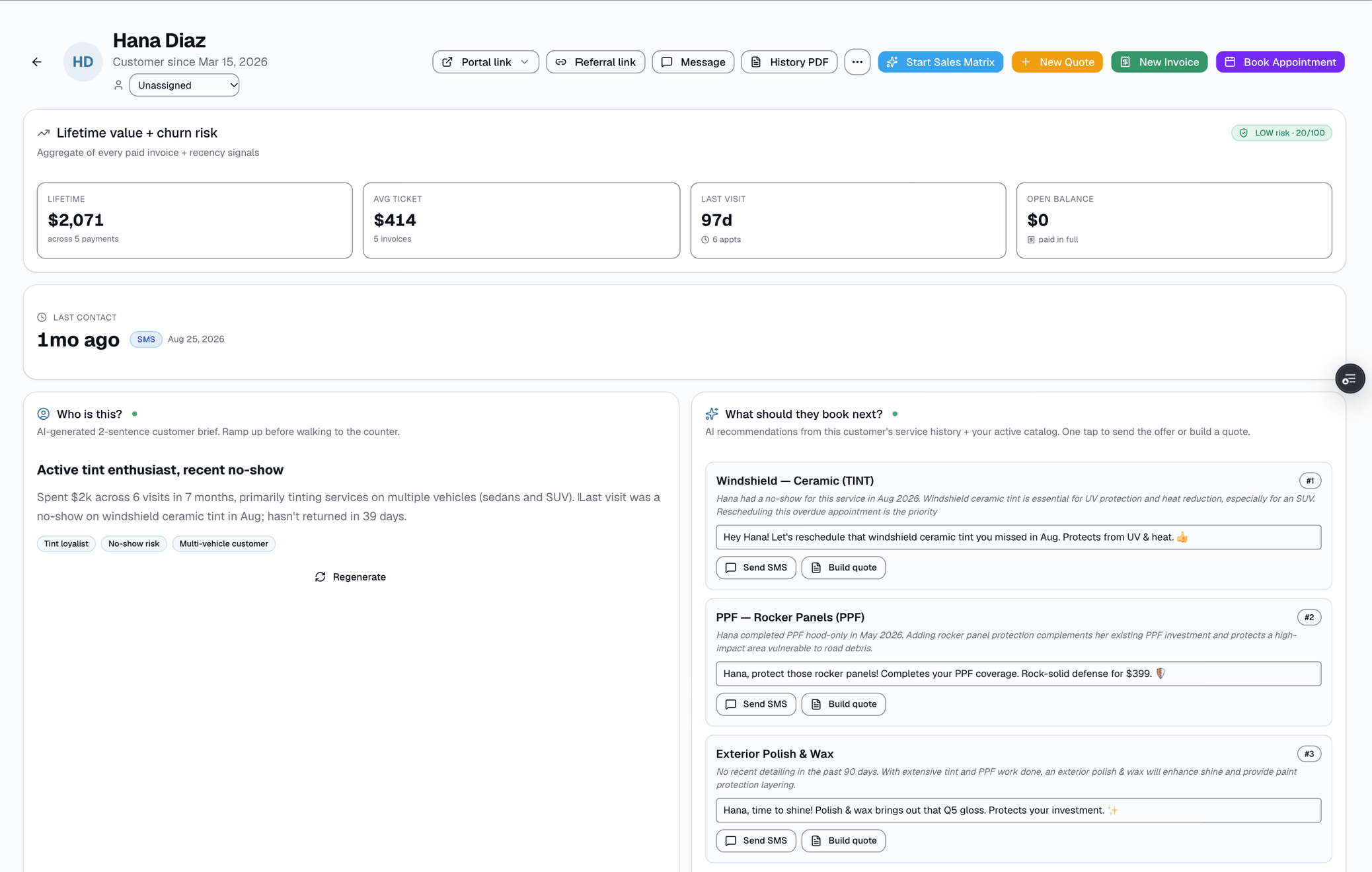
On any customer profile, click Generate suggestions and the AI reads that customer's real service history plus your active catalog, then proposes one to three services worth pitching next — ranked, each with a short reason and a ready-to-edit SMS pitch line that includes their first name. The model does the selecting and ranking; the code keeps it honest by only allowing services that exist in your catalog (it drops any the model invents) and capping the list at three.
No credit card
Cancel anytime
/app/customers/<id>
The quick version
Next-service ideas: Suggests the next one to three services to offer a customer.
- One click on a customer profile returns 1-3 ranked next-service suggestions (Growth and Pro plans)
- The AI model selects and ranks; results are constrained to your active catalog and capped at 3
- Each card has a reason and an SMS-ready pitch line with the customer's first name
Plans: Growth+ See pricingTry it in the Test Drive
It's advisory: each suggestion has a Send SMS button that opens the messages composer prefilled with the pitch, and a Build quote button that opens a new quote with the customer and service prefilled. You decide which to act on, edit the wording, and send. If no AI key is set, a deterministic catalog-gap heuristic fills in instead, so the button always returns something usable.
A closer look
01
The model ranks; the catalog keeps it honest
When you click Generate, a server query assembles the real picture for that customer — their most recent vehicle on file and their last several appointments with service names, categories, dates, and statuses — alongside your active service catalog with prices. That bundle goes to the fast AI model, which selects and ranks one to three services to pitch next and writes each one's reason and a short SMS pitch. The selection is the model's; the code's job is to constrain it. Any suggestion whose service id isn't actually in your catalog is dropped before it reaches you, and the list is hard-capped at three. So the recommendation is genuinely AI-ranked, and any pick tied to a catalog id is a service you really offer.
- Reads the customer's vehicle + recent appointment history and your active catalog
- The model chooses and ranks the 1-3 picks — selection is not a fixed rule
- Results filtered to real catalog service ids; invented ids are discarded
- Hard-capped at three suggestions, each with a reason and an SMS pitch line
/app/customers
02
Two ways to act — both human-initiated
Each suggestion is a card, not an action queue. A Send SMS button opens the messages composer for that customer with the pitch already typed in, so you can edit it and send from the conversation you'd use anyway. A Build quote button — shown when the suggestion maps to a real catalog service — opens a new quote with that customer and service prefilled, so you can turn the pitch into a priced quote in one step. Neither fires on its own: the AI proposes and prefills, and you are the one who actually sends the text or builds the quote. A small live/stub indicator shows whether the AI wrote the run or the deterministic fallback did.
- Send SMS → opens /app/inbox prefilled with the pitch for that customer
- Build quote → opens /app/quotes/new with the customer and service prefilled
- Quote isn't the only path — texting the pitch is an equal, first-class action
- Nothing is auto-sent; you review and send every suggestion by hand
/app/customers
Everything it does
The complete list. The plan tag above shows which plans include it.
- One click on a customer profile returns 1-3 ranked next-service suggestions (Growth and Pro plans)
- The AI model selects and ranks; results are constrained to your active catalog and capped at 3
- Each card has a reason and an SMS-ready pitch line with the customer's first name
- Two real actions per card: Send SMS (composer prefilled) and Build quote (when a catalog service is matched)
- Suggestions carrying a service id that isn't in your catalog are dropped; one with no service id can still come through, without a Build quote button
- A passive badge flags when the Sales Playbook already has a nudge queued, so you don't double-message
- Deterministic catalog-gap heuristic when ANTHROPIC_API_KEY is unset — the panel still works without AI
- Advisory and human-in-the-loop — you review every suggestion, edit it, and send it yourself
A tour of the screens
Every meaningful view, the path through it, and the moments that matter — so you know exactly what you're buying.
Send SMS or Build quote
Each card has two actions — Send SMS opens the composer prefilled with the pitch, Build quote opens a new quote prefilled with the customer and service.
You send; nothing is automatic.
/app/customers/<id>
Playbook-aware, so you don't double-message
A passive badge flags when the Sales Playbook already has a nudge queued for this customer.
It's context only — it doesn't drive the ranking.
/app/customers/<id>
Marcus T. · Customer profile
Sample Shop LLCWhat should they book next?
Next nudge in 4dThe Sales Playbook already has 2 nudges queued for Marcus, with the next one going out in 4 days. The badge is a heads-up so you don't fire a duplicate touch — it doesn't drive the ranking and isn't an opt-out.
Queued playbook nudges
- Ceramic upsell · SMSin 4 daysPending
- Review request · SMSin 11 daysPending
Context only — passive, never an opt-out, never drives the suggestions.
Who it's for
Built specifically for…
- Service writers working a callback list who want a fast, grounded 'what do I offer them next?'
- Owner-operators who know there's repeat revenue in their book but never get to mining it
- Shops that want to text a relevant offer or build a quote from a customer's real history in one tap
What it replaces
The old way…
- Eyeballing a customer's history to guess what they might want next
- Letting repeat-revenue opportunities sit because nobody has time to work the book
- Typing the same upsell pitch from scratch for every returning customer
Setting it up
- 1
1. Open a customer, click Generate
On any customer profile, the next-service panel sits collapsed behind a Generate suggestions button so the page stays light. Click it and a server query pulls that customer's vehicle, recent appointment history, and your active catalog — all scoped to your shop.
- 2
2. AI ranks 1-3 services to pitch
The history and catalog go to the fast AI model, which selects and ranks one to three services and writes each one's reason and an SMS pitch line. Picks are constrained to your real catalog and capped at three. With no AI key set, a deterministic catalog-gap heuristic fills the same fields instead.
- 3
3. You send the text or build the quote
Each card gives you a Send SMS button (composer prefilled with the pitch) and, when a catalog service is matched, a Build quote button (new quote prefilled with the customer and service). You review, edit, and act — nothing goes out until you do.
What this looks like in a shop
Illustrative scenario: a service writer at Sample Shop LLC opens a returning customer who's had window tint done but never ceramic. She clicks Generate suggestions and the panel returns two ranked picks from the shop's own catalog — a ceramic coating with a reason noting the tint-only history, and a maintenance detail — each with a short pitch line that already includes the customer's first name. She taps Send SMS on the ceramic pick, tightens one sentence in the composer, and sends; for the second she taps Build quote to price it out. This is the intended workflow, not a reported result.
Good to know
- Which plan includes next-service ideas?
- Growth and Pro include it. See the Pricing page for everything in each plan.
- Does it text customers or create quotes automatically?
- No. Each suggestion is a card with two buttons: Send SMS opens the messages composer prefilled with the pitch, and Build quote opens a new quote prefilled with the customer and service. Both require you to act — the AI proposes and prefills, but you review, edit, and send. Nothing is sent or created on its own.
- Can it suggest a service I don't offer?
- Rarely. The model is told to choose from your services only, and any suggestion carrying a service id that isn't in your catalog is dropped in code; a suggestion with no service id at all isn't dropped, but it gets no Build quote button. The list is also capped at three.
- What is the 'nudge already queued' badge?
- It's a passive heads-up. If the Sales Playbook already has an upcoming nudge queued for this customer, the panel shows a small badge (for example, the count queued and how many days until the next one) so you don't fire a duplicate touch. The playbook doesn't drive the ranking and the badge isn't an opt-out — it's just context.
- What if my shop doesn't have an AI key configured?
- The panel still works. Without an AI key it falls back to a deterministic catalog-gap heuristic — surfacing affordable services in categories the customer hasn't bought yet — and writes a simple pitch for each. You lose the AI ranking and phrasing, not the panel.
Works with your stack
An
Anthropic Claude
Selects and ranks the 1-3 next-service picks and writes each pitch (fast model)
Tw
Twilio
Carries the pitch you choose to send through the messages composer
Pairs well with
Customer CRM
Search by name, plate, or VIN in milliseconds. Every appointment, quote, invoice, warranty, and photo attached to the right record — forever.
Learn more
Sales playbook
On Growth and Pro: up to six scheduled nudges per paid invoice over a year — review, warranty (film services only), cross-sell, maintenance, win-back, anniversary — with reply intent AI-classified and acted on automatically. Only the cross-sell step's pitch line is AI-written per customer; the other five are editable template copy.
Learn more
Quotes
Build a quote from real line items — services, film, parts, fees — send it, and the customer approves with a drawn signature and a card deposit on their phone. No account needed on either side.
Learn more
Two-way SMS
Every customer conversation in one inbox. Auto-reminders run 24/7, but when they reply, a human sees it. MMS, templates, merge fields.
Learn more