Loading
Built-in staff training
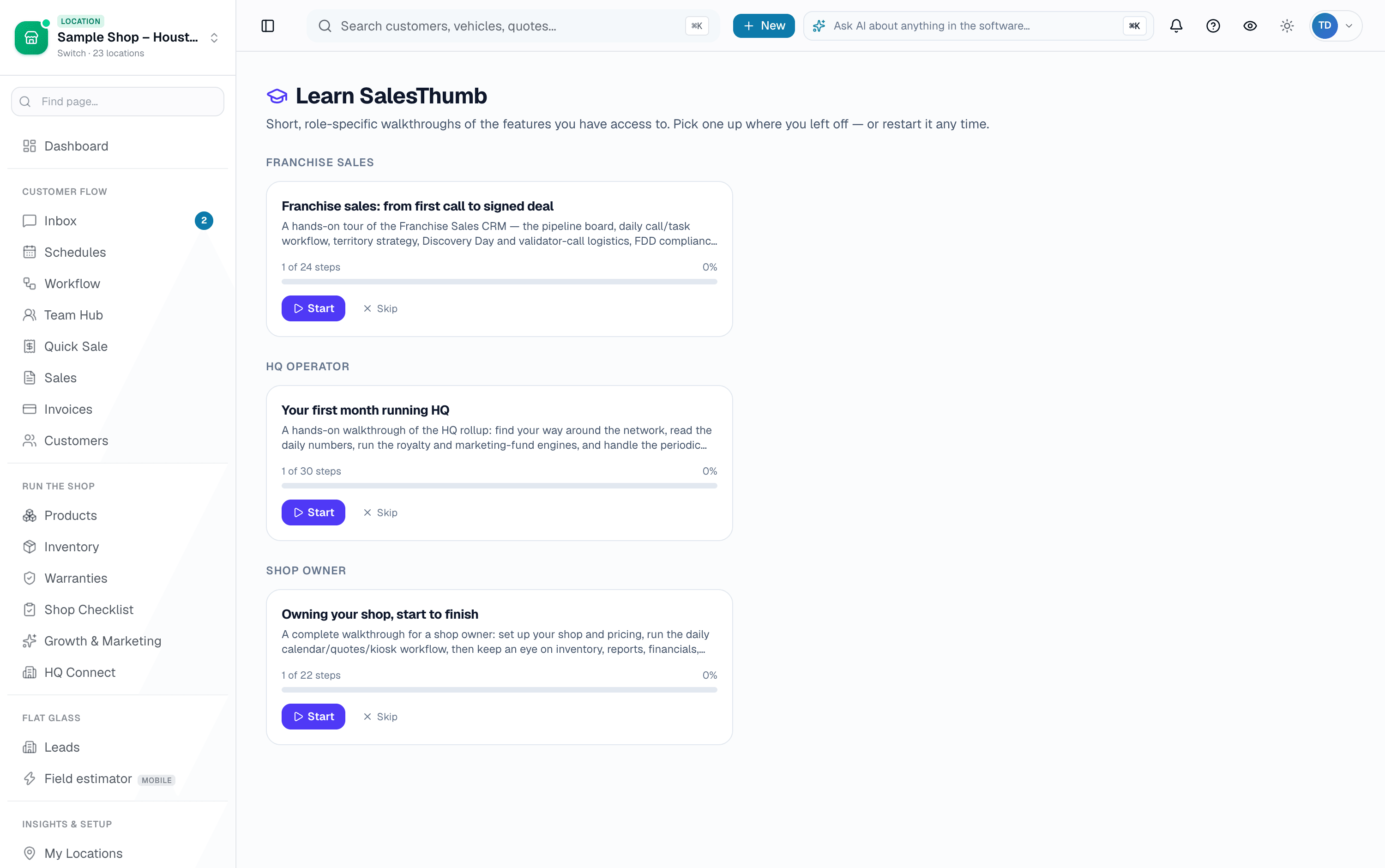
New hire's first day: the app shows them where everything is.
Most software either dumps a new hire into an empty dashboard or hands them a PDF nobody reads past page one. SalesThumb's Training Wizard is built into the product itself: a role-matched set of short tours a technician, front-desk hire, manager, or HQ operator can start the moment they log in. Some steps just explain a screen; others spotlight a real button and don't advance until the person has actually clicked it. Progress is saved automatically, so a tour interrupted at step 3 picks back up at step 3 — not step 1 — whenever they return.
No credit card
Cancel anytime
/app/learn
Features, zoomed in
The parts that actually move the needle.
Three capabilities built specifically for the day-to-day of a working shop.
Deep dive · 01
Three kinds of steps, not one slideshow format
A tour isn't a flat stack of description cards. "Intro" steps are centered cards for context that doesn't map to one screen. "Tour" steps spotlight a real element on a real page — the tour navigates there for you, dims everything else, and draws a highlight ring around exactly what it's talking about. "Try it" steps go one step further: the highlighted action has to actually be performed, and the tour waits for an explicit "I did it" before moving on, rather than guessing whether the person followed along.
- Tour steps auto-navigate to the right page, then spotlight the specific element
- Try-it steps advance on explicit confirmation, never an auto-detected click
- Intro steps stay a plain centered card for anything that isn't tied to one screen
app.salesthumb.com
Three kinds of steps, not one slideshow format
Screenshot coming soon
Deep dive · 02
Shows up when it's relevant, not just once
A soft banner offers a not-yet-started tour on the pages it applies to — easy to dismiss for the session, never a forced modal. Dismissing it doesn't delete the tour: it comes back another session if the tour still hasn't been started, skipped, or completed. The /learn hub is the permanent home either way: every tour for your role, grouped by role, with a progress bar and Continue / Reset / Skip on each one. Finishing a tour doesn't archive it — it stays in the hub to replay any time a refresher is needed, which matters more for the tours nobody uses daily (an HQ operator's royalty-period close, a franchise-sales rep's discovery-day checklist).
- Banner is a dismissible nudge, never a forced modal — dismissing it doesn't stop the tour from being available at /learn
- /learn hub lists every tour for your role with Continue / Reset / Skip
- Completed tours stay available to replay — nothing disappears after finishing once
app.salesthumb.com
Shows up when it's relevant, not just once
Screenshot coming soon
What's included
The full capability list.
Everything that ships on day one. No feature-gating surprises inside a single plan.
- 12 role-matched tours across 9 roles today — shop owner, manager, technician, front desk, service writer, HQ operator, franchise sales, org viewer, and super admin each see only the tours built for them
- Live spotlight, not a slideshow — "tour" steps highlight the actual UI element on the actual page, navigating there automatically if needed
- "Try it" steps require the real action — an "I did it" button advances the tour only after the person performs the step themselves; nothing is auto-detected
- Resumable — progress (current step, started/completed/skipped) is saved per person, so leaving mid-tour and coming back continues exactly where they left off
- Two entry points: a soft, dismissible banner that offers any not-yet-started tour on the pages it's relevant to, and a permanent /learn hub to start, reset, or skip any tour for your role at any time
- Steps can be gated to a specific permission — a step covering how to issue a refund only appears to someone who can actually issue refunds
See every angle
A tour of the screens
Every meaningful view, the path through it, and the moments that matter — so you know exactly what you're buying.
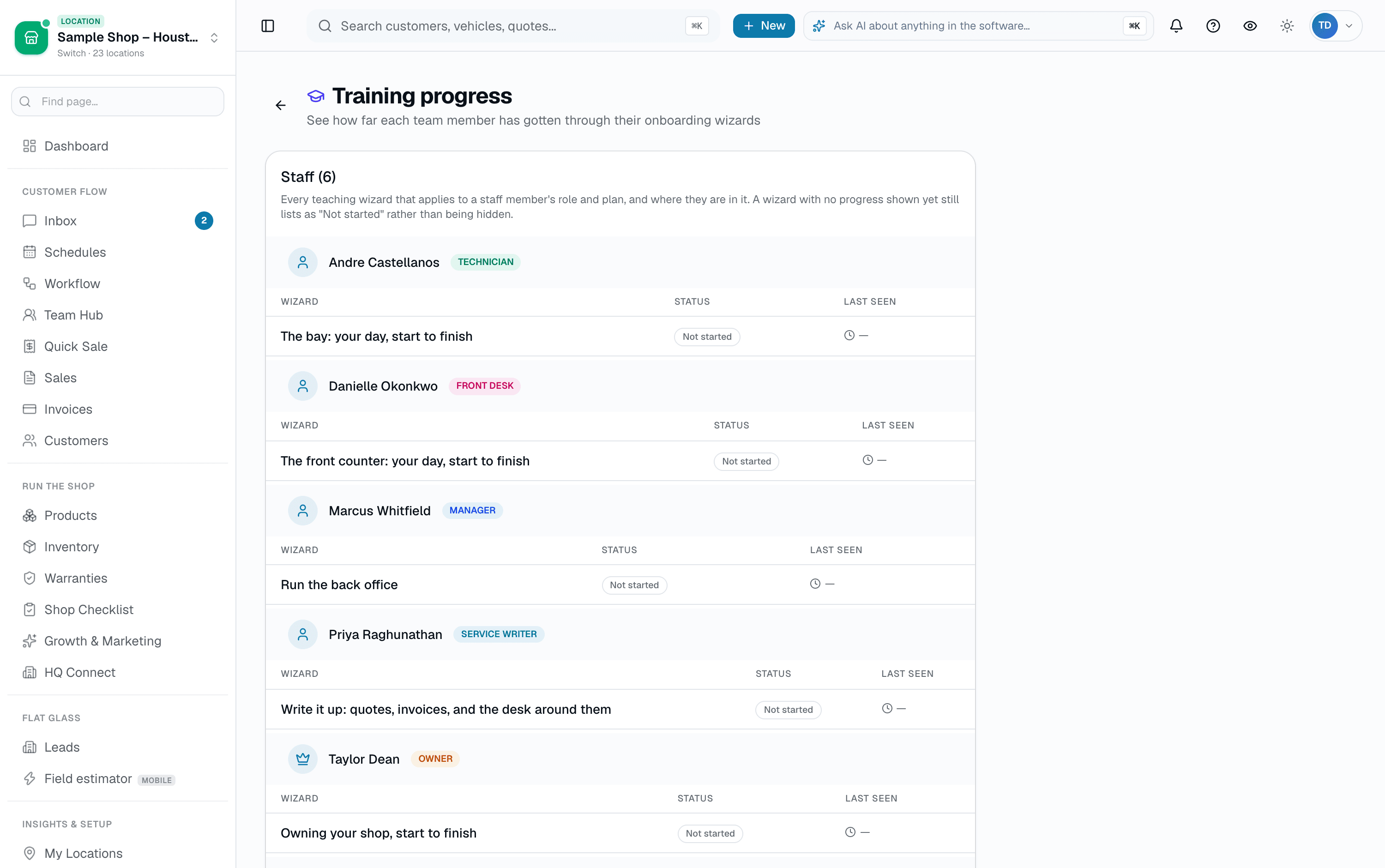
Who's started, who hasn't
Training progress per team member — which wizards apply to them, and where they are in each one.
A wizard nobody has opened still lists as "Not started" rather than being hidden.
/app/settings/team/training
Who it's for
Built specifically for…
- Multi-location shops onboarding a new technician or front-desk hire every few weeks
- Owners who don't want to personally walk every new hire through the software
- HQ operators bringing a new franchise location's team up to speed on royalty, reporting, and the tools specific to their role
What it replaces
The old way…
- A printed or PDF training manual nobody reopens after day one
- A one-time training session that's half-forgotten by the following week
- Pulling a manager off the floor to personally walk a new hire through the calendar, quotes, and inventory
How it works
Set it up once. Run it forever.
- 1
1. The right tours surface automatically
Tours are matched to the person's role — a technician and a front-desk hire see different tours, and someone with more than one role (e.g. an HQ operator who's also a shop owner) sees every tour that applies.
- 2
2. Each step shows, not just tells
"Tour" steps navigate to and spotlight the real screen; "try it" steps wait for the person to actually perform the action before advancing.
- 3
3. Pick up where you left off
Progress saves automatically. Anyone can resume, reset, or skip any tour for their role from /learn at any time — finishing once doesn't remove it from the hub.
What this looks like in a shop
Illustrative scenario: a shop hires a new technician who logs in for the first time and sees a small banner offering the Technician tour. She starts it — a few intro cards on what her role can see, then a "tour" step spotlights the calendar and walks her through today's jobs, then a "try it" step has her actually open a real job and mark a status change before the tour advances. She gets pulled away mid-tour for an install; when she comes back that evening, /learn shows the tour exactly where she left it. She finishes it over her first two shifts instead of one overwhelming session.
Questions
Good to know.
- Does it just describe features, or does it actually show me?
- Both, depending on the step. Some steps are plain explanatory cards, but "tour" and "try it" steps spotlight the real element on the real page — the tour navigates there and highlights exactly what it's talking about, rather than describing it in the abstract.
- What happens if I get interrupted in the middle of a tour?
- Progress saves automatically as you move through each step. Closing the tour or leaving the app doesn't lose your place — it resumes at the same step next time.
- Can I skip it, or does every new hire have to sit through it?
- It can be skipped at any point, from the banner or from within the tour itself. Skipping doesn't delete the tour — it stays available in /learn to start whenever someone's ready.
- Does every role see the same training?
- No — tours are built per role (shop owner, manager, technician, front desk, service writer, HQ operator, franchise sales, org viewer, super admin), and an individual step inside a tour can be limited further to only show to someone who actually holds the permission it covers.
- Is this the same as the setup flow when I first create my shop?
- No — shop setup (configuring your services, hours, and booking policy) is a separate one-time flow. The Training Wizard is ongoing, per-person, role-based training on how to use the software day to day.
Explore more
Pairs well with
Mobile Apps
The installer app shows today's schedule, captures photos, clocks in/out, and updates job status. The customer app shows their active job's progress, appointments, quotes, invoices, and warranty status. Both are native iOS + Android apps, live now on the App Store and Google Play as the SalesThumb app; a fully white-labeled app under your own brand is further out on the roadmap.
Learn more
Multi-Location HQ
Whether you're a solo operator or a franchisor with hundreds of locations, every shop rolls up into one HQ view with consolidated KPIs, centralized catalogs, and push-to-shop pricing and templates.
Learn more
Staff login
Email + password, the same Better-Auth session that powers the web app. Token stored on-device, sent as a Bearer header on every API call — sign in once, stay signed in.
Learn more